
Lily AI Reviews
Increase ad revenue and search visibility by enriching catalog attributes for shopping bots and ad algorithms using automated experimentation.
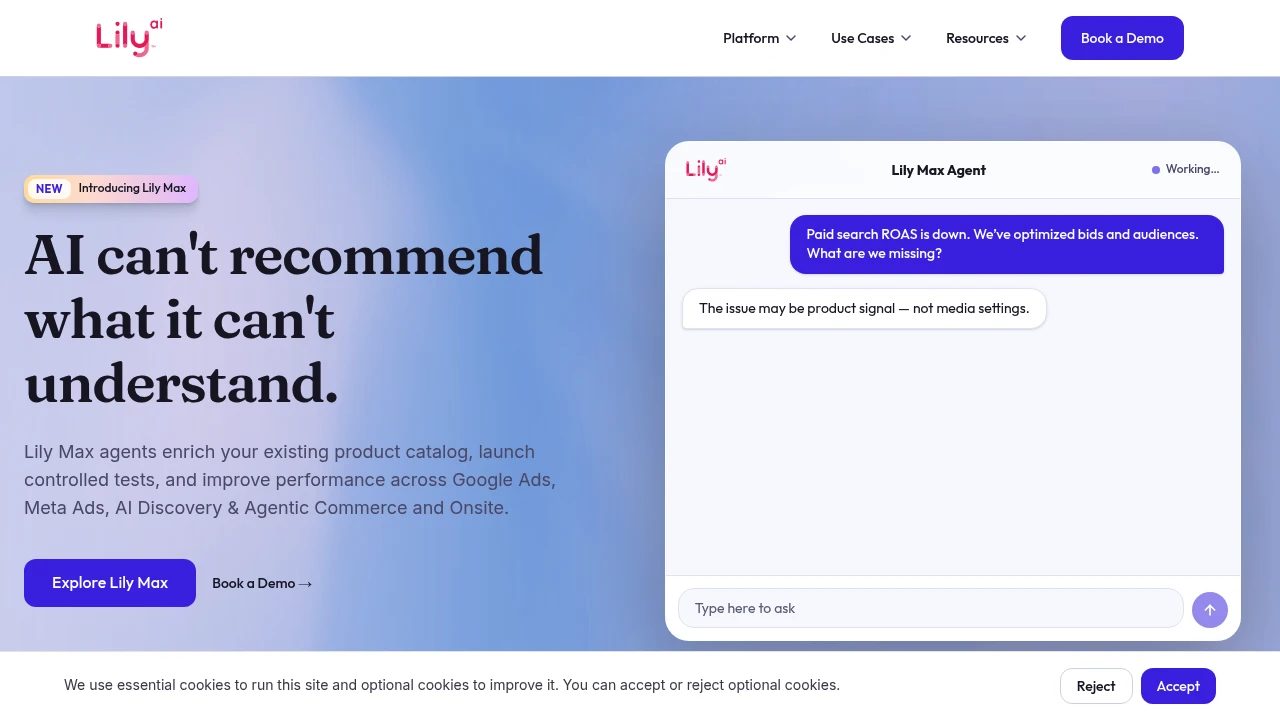
Transforming raw e-commerce catalog feeds into structured, machine-readable attributes helps search algorithms and generative shopping bots understand inventory nuances. Performance marketing directors and e-commerce merchandising leads at large apparel, footwear, and consumer retail brands hire this engine to solve thin product metadata. Standard feed syndication tools merely transport existing descriptions, leaving blanks across conversational attributes, fit specifications, and styling occasions.
By evaluating product detail pages against customer query patterns, the platform automatically expands feed payloads with schema-validated attributes. It connects directly with existing catalog workflows and validates every attribute change through matched-spend holdout experiments on Google Shopping and Meta Advantage+ campaigns, confirming conversion lift before full deployment.
- Enterprise apparel merchandisers expanding catalog attributes
- Paid search managers auditing Google Merchant Center feeds
- Growth marketers optimizing Meta Advantage+ catalog campaigns
- Digital commerce teams structuring feeds for AI search agents
- Onsite search leads reducing zero-result queries
Lily AI Key Features
- Agentic Catalog EnrichmentUses goal-based AI agents to enrich product data with structured attributes, descriptions, metadata, and schema markup.
- Controlled A/B Testing and MeasurementMeasures performance impact with matched-spend A/B tests, holdout groups, and gap analysis across commerce channels.
- Multi-Surface OptimizationOptimizes product intelligence across Google Ads, Meta Ads, LLM discovery surfaces, and onsite search.
- Agent-Ready Payload GenerationTransforms live PDP data into schema-validated payloads that AI shopping engines and agents can read and recommend.
- Continuous Catalog UpdatingContinuously collects performance signals to evaluate, enrich, and republish product intelligence.
Lily AI Pricing
For growing brands getting started with AI retail media on a single primary channel.
- Single primary channel
- Catalog ingestion
- Product-data scoring
- Enrichment on highest-impact gaps
- Matched-spend testing
For multi-channel brands scaling spend across Google Ads, Meta Ads, and onsite.
- Scaling spend across Google Ads, Meta Ads, and onsite
- Continuous optimization loops
- Broader catalog coverage
- Cross-channel testing cadence
- Human approval before anything ships to feeds
For large retailers and marketplaces with complex catalogs and governance needs.
- Dedicated support
- Custom SLAs
- Security and compliance review
- Readiness for emerging AI-discovery and agentic-commerce surfaces
Pricing is sourced from Lily AI's website and may be out of date — check their site for current pricing.
Write a verified review of Lily AI and we'll send you a $50 Amazon gift card once it's published.
Write a reviewOne gift card per person, for a verified review that meets our quality bar. Full terms.


